
Your Cornmeal Side Sets the Tone for the Whole Plate
Ordering a plate of fried catfish in Denison and Grayson County means confronting a structural physics question before the basket ever hits the table. Fried catfish already supplies an audible, starch-crisped crunch. Tartar sauce sits beside it as a cool, high-fat emulsion ready for dipping, while a bowl of brothy pinto beans introduces an explicit liquid-management task. Your cornmeal side determines whether that dinner doubles down on crisp, fried bites or introduces a softer structural contrast engineered to catch bean broth.
I evaluate Southern sides by looking at how heat transfer shapes cornmeal batter into two distinct mechanical formats. Hushpuppies are individually fried cornmeal bites defined by a crisp, golden shell wrapped completely around a steamed, tender center. Skillet cornbread is a baked cornmeal bread cut into wedges, where conductive heat from a hot pan builds a browned bottom and edge crust around an open, sliceable crumb.
The choice comes down to the specific dinner in front of you. When your meal centers on fried catfish fillets, tartar sauce, and Southern beans, you have to decide whether your palate wants another crisp bite right beside the fish or a tender wedge that can soak up seasoned liquid.
Hushpuppies and Skillet Cornbread, Side by Side
Comparing these two cornmeal formats requires looking at the physical jobs they perform on a plate—dipping, soaking, crumbling, and alternating textures—rather than scoring one above the other. The matrix below breaks down how thermal method and physical geometry translate into a practical dining decision.
| Plate question | Hushpuppies | Skillet cornbread | What the difference means on a catfish plate |
|---|---|---|---|
| Cooking method | Individually fried cornmeal bites | Cornmeal bread baked in a skillet and cut into wedges | Frying surrounds every single piece in oil-browned crust; baking concentrates crust along the pan-contact surfaces. |
| Exterior | Crisp, irregular fried shell | Browned bottom crust and crisp outer edge | Hushpuppies deliver a shell on every bite, whereas cornbread lets you choose between crusted edges and softer faces. |
| Interior | Tender, steamed cornmeal center enclosed in the shell | Exposed, sliceable yellow crumb | A hushpuppy locks its steam inside until bitten; cornbread exposes its porous crumb immediately to air, butter, or broth. |
| Sweetness | Preparation-dependent; ranges from savory to sweet | Preparation-dependent; ranges from savory to sweet | Neither frying nor baking dictates sugar levels, so you must ask how the kitchen seasons the batter. |
| Sauce handling | Compact, rigid shape built for direct dipping | Broad wedge better suited as a chaser than a dipper | Hushpuppies scoop thick tartar sauce cleanly without breaking; cornbread works better eaten between forkfuls of sauced fish. |
| Bean pairing | Sits alongside the bowl to keep crunch intact | Crumbles into the bowl or rests on the rim to absorb broth | Cornbread's open cell structure pulls pinto liquid inward, while a hushpuppy's fried barrier resists soaking. |
| Eating style | Finger-food bites eaten in one or two snaps | Fork-or-hand wedge broken into custom pieces | Hushpuppies keep the meal's rhythm fast and crisp; cornbread slows the pace with varied bites. |
Choose Between a Crisp Shell and a Crusty Wedge
Think about which part of a fried catfish fillet you anticipate most when sitting down at a food stop on a Texas road trip. Diners who crave the acoustic snap of cornmeal dredge have a clear mechanical reason to choose hushpuppies. Diners looking for a tender interval between pieces of fried fish have an equally sound reason to reach for skillet cornbread.
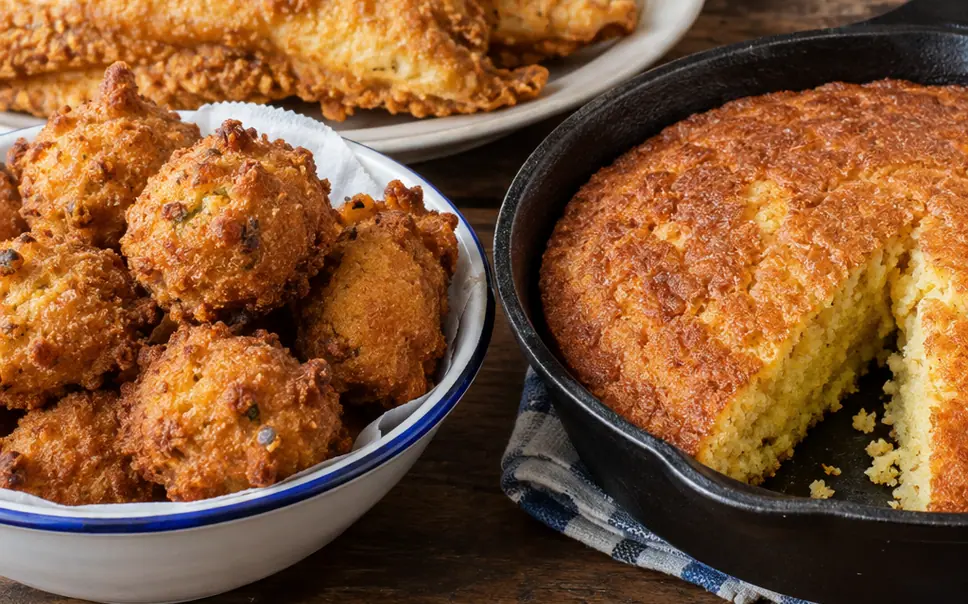
Submerging a scoop of batter into hot fryer oil causes rapid surface dehydration and Maillard browning across the entire exterior at once. That thermal shock forms a rigid, blistered shell while water vapor trapped inside gelatinizes the starches into a soft, cohesive center. Because the geometry is roughly spherical or oblong, every bite forces your teeth through the crisp outer shell and into the tender interior simultaneously. You repeat the exact structural experience of eating fried catfish coating.
Skillet cornbread distributes heat and crust differently. When batter meets a preheated cast-iron skillet, intense conductive heat sears the bottom and outer perimeter into a firm, browned crust, while radiant oven heat bakes the upper middle into a distinct, sliceable crumb. Mistaking skillet cornbread for a uniformly soft bread misses the physics of the pan.
A cut wedge gives you three distinct textural zones on a single plate. You can snap off the crisp back corner where the batter met the iron wall, take a forkful of the open interior crumb, or eat a warm section where melted butter has wicked into the yellow cornmeal. Instead of repeating the same shell-to-center ratio on every chew, a cornbread wedge lets you alternate textures between bites of catfish.
Sweetness, Onion, and Butter Change the Match
A skillet wedge has a crust, and a fried cornmeal bite can be sweet: texture and sweetness belong on separate decision lines. Deep-frying does not automatically make a hushpuppy savory, and baking in iron does not automatically make cornbread sweet or cake-like. Both formats rely on the kitchen's dry-mix ratio, which means sugar and aromatics shift the pairing dynamics independent of the cooking vessel.
Ask Before Ordering: Recipes vary from kitchen to kitchen, so ask your server whether the hushpuppies or cornbread run sweet or savory before locking in your side.
When I assess how seasoning alters a catfish dinner, I look at three formulation variables that change how the cornmeal interacts with salted fish:
- Onion-forward hushpuppies: Diced yellow or green onion folded into hushpuppy batter releases sulfur aromatics as the water inside the vegetable steams during frying. That savory, allium-heavy profile bridges the gap between earthy cornmeal and mild white catfish meat, though onion remains a preparation choice rather than a guaranteed ingredient.
- Sugar levels in either format: Sweeter versions of hushpuppies or cornbread introduce a deliberate flavor counterpoint against salty, peppered catfish dredge. Less-sweet versions strip away that confectionary contrast, keeping your palate focused squarely on roasted corn flavor, fried fish, and black pepper. Neither preparation holds an exclusive claim to being more properly Southern; each simply steers the plate toward contrast or continuity.
- Butter as a surface finish: Brushing or melting butter onto hot skillet cornbread adds dairy fat that lubricates the dry crumb and rounds out sharp seasoning on the fish. Butter is an optional finish that adds richness rather than a built-in definition of skillet cornbread itself.
Decide first whether your plate needs a sweet foil against salt or a straightforward corn-and-seasoning companion. Once you know that preference, ask how the house mixes its batter before choosing the format.
Match the Side to Your Tartar Sauce and Beans
The catfish-plate job split comes down to two physical tasks at the table: hushpuppy shell for tartar dipping, cornbread crumb for pinto-broth soaking. Identifying which accompaniment dominates your meal settles the side decision immediately.
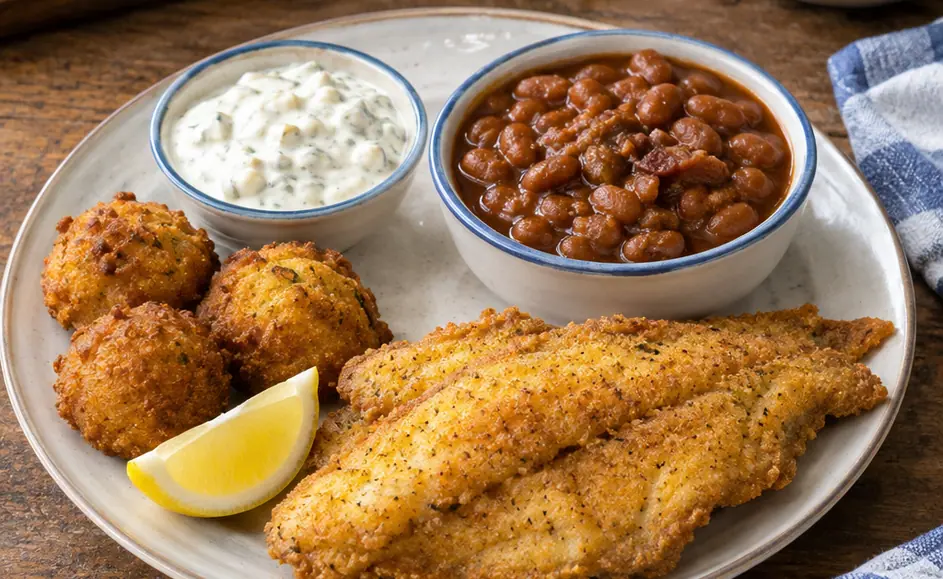
For repeated dips into a cup of tartar sauce, choose hushpuppies. A hushpuppy's compact, self-contained shape makes it effortless to grip between two fingers and plunge one end straight into a small condiment cup. Because the fried exterior forms a sealed, rigid lattice, it supports the weight of thick mayonnaise, chopped pickle relish, and herbs without crumbling into the cup. You get an immediate temperature and texture collision: cool, creamy emulsion sitting directly on a hot, crisp cornmeal surface.
Skillet cornbread handles tartar sauce through pacing rather than dipping. Trying to dip a cut wedge of cornbread into a condiment cup usually shears the open crumb and leaves yellow crumbs behind in the sauce. Instead, cornbread works alongside tartar-sauced catfish as a sequential bite. Taking a forkful of crispy fish dressed in tangy tartar sauce and following it immediately with a plain or buttered bite of cornbread resets the palate with a drier, softer texture.
When a bowl of Southern beans sits beside your plate, the capillary physics reverse. Brothy pinto beans demand liquid absorption, which is the exact mechanical job skillet cornbread's open cell structure performs best. You can crumble half a wedge directly into the bowl to thicken the pot likker, or rest a cut wedge against the rim so the porous yellow crumb wicks up the savory bean broth on contact.
What if the kitchen serves thick, sweet baked beans instead of brothy pintos? Heavy molasses-and-sugar sauces do not need structural soaking, so the decision shifts back to total plate sweetness—pairing sweet beans with a savory hushpuppy or a less-sweet cornbread keeps the dinner from tipping into dessert territory. And if you prefer your pinto beans and your bread to remain completely separate, ordering hushpuppies lets you spoon broth from the bowl while keeping crisp cornmeal bites dry on the main plate.
Choose Differently for a Hot Plate and a Takeout Box
A day around Lake Texoma & Eisenhower State Park often means deciding between sitting down at a booth right away or packing a meal back to a cabin, boat ramp, or picnic table. Serving conditions alter the thermodynamics of fried and baked cornmeal the moment the food leaves the pass.
Dine-In Immediately After Frying
When you eat your meal as soon as the basket lands on the table, prioritize freshly served hushpuppies if crunch is your primary goal. Right out of the fryer, moisture inside the hushpuppy is still migrating outward as steam, and the surrounding air in the dining room allows that vapor to escape cleanly. The crust stays brittle and audible.
Packing a Meal for the Road
Enclosing hot food inside a takeout container changes the humidity environment completely. Steam radiating off hot catfish fillets and hushpuppies hits the closed lid, condenses, and falls back onto the food. Trapped steam softens a fried crust rapidly, erasing the exact textural feature that makes hushpuppies appealing to crunch-seekers in the first place.
Skillet cornbread tolerates travel differently because its appeal rests heavily on its interior crumb rather than a uniformly crisp shell. Even when the bottom crust softens slightly in transit, a tender wedge meant for crumbling into pinto beans or spreading with butter still performs its primary job at the picnic table.
Pack Smart For Transit: Ask for tartar sauce in a sealed side cup, keep both hushpuppies and cornbread completely out of bean liquid until you sit down, and keep cornbread covered during the drive so the open crumb does not dry out.
These packing adjustments help protect texture on the drive, though container venting, trapped moisture, and the minutes elapsed before eating will still shape how crisp any takeout plate stays. As you build out a travel order, size your portions around the fish fillets, bean bowls, other sides, and your own appetite after a day outdoors rather than assuming either cornmeal option is automatically lighter.
Pick the Side for the Catfish Dinner You Actually Want
Rather than treating hushpuppies or cornbread as a default afterthought, build your order around two distinct plate blueprints that match how you eat.
Plate One: The High-Crunch Dipper
Order fried catfish fillets, tartar sauce, and hushpuppies. This plate is built for the diner who wants maximum structural crunch and a fast, finger-food rhythm. You alternate between crisp strips of cornmeal-crusted catfish and crisp, sphere-shaped hushpuppies, using both as rigid vehicles to scoop cold, creamy tartar sauce on every other bite.
Plate Two: The Broth-Soaking Contrast
Order fried catfish fillets, a bowl of brothy pinto beans, and a wedge of skillet cornbread. This setup serves the diner who wants textural relief between pieces of fried fish and a tool to capture seasoned bean liquid. You get the snap of fried catfish first, followed by a tender, sliceable crumb that you can butter on the plate or crumble straight into the warm pinto broth.
When a dining room offers both sides on the menu and you are eating with a companion, splitting an order of hushpuppies and an order of skillet cornbread covers both mechanical jobs across the table without compromise. For your next catfish plate, do you want another crisp bite to dip in tartar sauce, or a warm wedge to soak up the beans?
Responses
Nothing here yet. Add your opinion.
Join the Discussion